
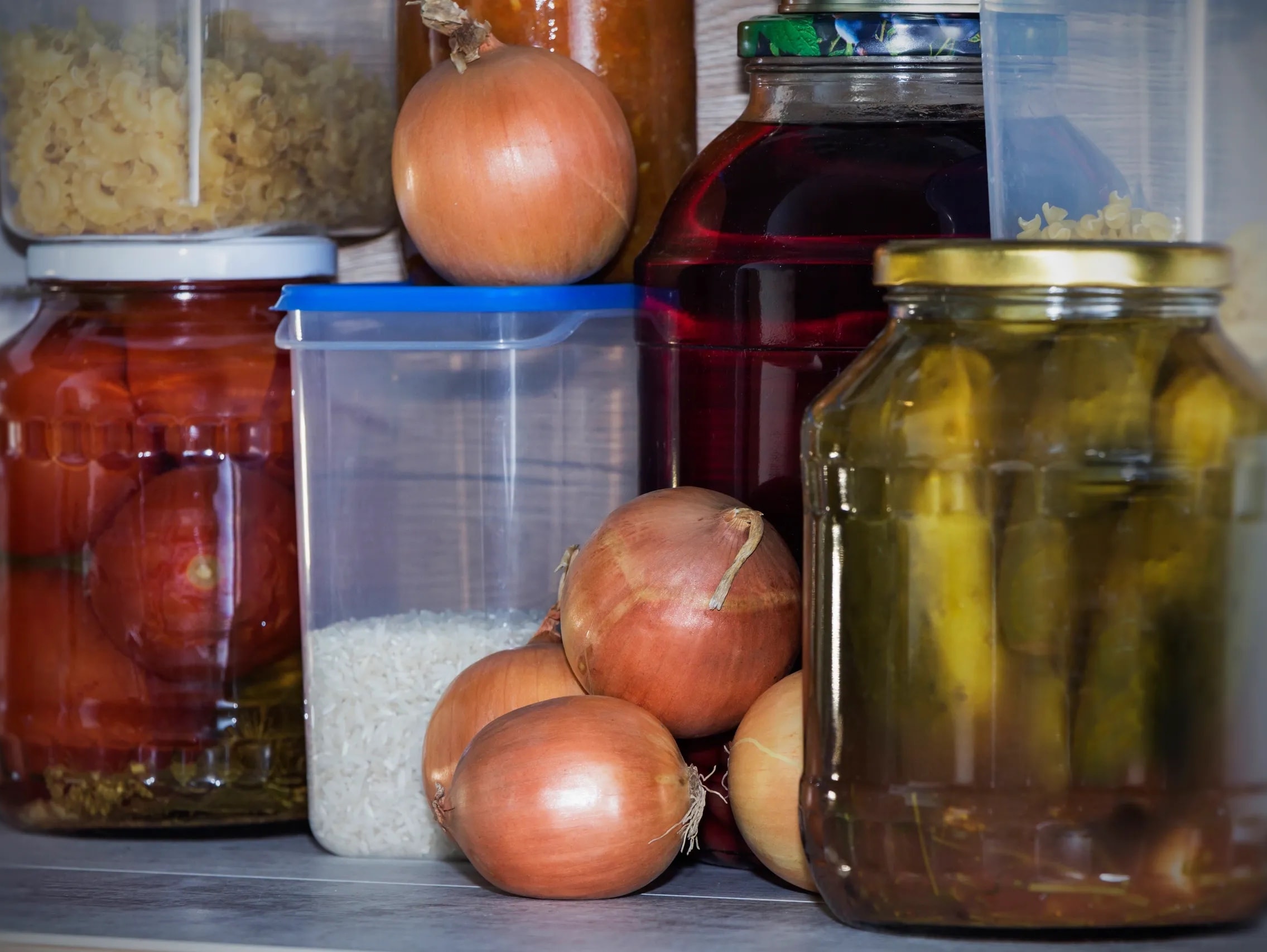
There is a particular kind of abundance that has very little to do with having a lot.
It is opening the cupboard at the end of a long day and knowing there is rice. Knowing there are potatoes tucked somewhere cool and dark, an onion waiting on the counter, eggs and butter in the refrigerator, salt near the stove, cumin and oregano somewhere within reach. Knowing that even if there isn't much else, there is enough to begin.
This is my list of those things.
It isn't a definitive list of what belongs in a healthy kitchen. It isn't a checklist you need to complete before you can start cooking well. And it certainly isn't an argument for throwing away what is already in your pantry and buying everything again.
Think of it instead as a foundation—a small collection of ingredients and tools that can turn whatever you happen to bring home into dinner.
On the Counter
A good chef's knife
If I could choose one place to spend money in a kitchen, it would probably be here.
You don't need a block filled with twelve specialized knives. A comfortable, sharp chef's knife can do most of what an everyday cook needs: onions, herbs, vegetables, meat, fruit. Add a paring knife and a serrated bread knife over time and you have a remarkably capable little set.
More importantly, a good knife changes your relationship with cooking. Preparation becomes less frustrating. Chopping an onion stops feeling like an obstacle between you and dinner.
Eventually, I want Ground and Thread to help put good knives into kitchens where cost has made them a luxury. Cooking at home shouldn't require expensive equipment, but everyone deserves tools that are safe, durable, and pleasurable to use.
Beside the Stove
Olive oil and avocado oil
Olive oil is the bottle I reach for most often—for vegetables, beans, marinades, sauces, eggs, and finishing something just before it reaches the table.
Avocado oil is useful when I want something more neutral in flavor or I'm cooking at higher temperatures.
You don't necessarily need both. If the budget only allows one, buy the oil that makes sense for the foods you actually cook.
There is a much larger conversation here about cooking oils, seed oils, internet nutrition claims, and what the evidence actually tells us. We'll give that conversation its own space. Food shouldn't become frightening simply because an ingredient has acquired a bad reputation online.
Maldon sea salt
This is admittedly one of the indulgences on my list.
For everyday cooking, an inexpensive kosher or sea salt works beautifully. Maldon is different: delicate flakes that you can crush between your fingers over roasted vegetables, eggs, tomatoes, meat, or even something sweet.
It reminds us that sometimes an ingredient earns its place not because we need it, but because a small amount of pleasure matters too.
Black pepper
Preferably freshly ground, but perfection is not required.
Italian seasoning, oregano, and cumin
Three inexpensive jars can travel surprisingly far.
Oregano and cumin carry you toward beans, rice, chiles, meats, soups, and many of the flavors familiar across Mexican and Latin American kitchens. Italian seasoning moves easily into roasted vegetables, chicken, tomato sauces, marinades, and pasta.
They aren't rules. They're starting points.
In the Pantry
Jasmine rice
There should always be a starch that can become the beginning of a meal.
For me, jasmine rice is one of them. It is inexpensive, forgiving, keeps for a long time, and can sit beneath almost anything: beans, vegetables, eggs, chicken, stews, something simmered in chile.
Rice is also a reminder that nourishment doesn't need to be complicated to be complete.
Yellow and purple onions
Few ingredients ask for so little and give back so much.
Onions are relatively inexpensive, remarkably versatile, and, when stored somewhere cool, dry, and well ventilated, have a forgiving shelf life compared with many fresh vegetables. That matters. Keeping food around isn't very useful if half of it ends up forgotten and spoiled before we have time to cook it.
Yellow onions are the workhorse: soups, beans, sauces, roasted vegetables, eggs, meat. Purple—or red—onions bring a sharper brightness and are especially good raw, pickled, charred, or scattered over something just before serving.
An onion in the house means you're already partway toward dinner.
Potatoes
Potatoes are another food I like having around precisely because they wait for you.
Stored properly, they can last considerably longer than many fresh vegetables, and when groceries are running low, a few potatoes can become breakfast, a side dish, a soup, or the foundation of dinner.
They can also rescue that particular evening when you look around the kitchen and think there is nothing to make. Potatoes, onion, some ground meat, tomato and spices—and suddenly you are not improvising out of scarcity.
You're making picadillo.
We'll come back to that dish in its own post, because some foods deserve more than a passing mention.
Dark brown sugar
Not because sugar needs to masquerade as health food.
Because sweetness belongs in a kitchen.
Dark brown sugar brings molasses, depth, and warmth. A spoonful can balance acidity in a sauce, deepen a marinade, soften the edges of something spicy, or become the beginning of dessert.
A philosophy of eating that has no room for sweetness probably has too little room for being human.
In the Refrigerator
Free-range eggs
Eggs might be one of the most useful foods in the refrigerator.
They can become breakfast in minutes, but they don't belong only to breakfast. Put one over leftover rice. Fold vegetables and potatoes into an omelet. Add a boiled egg to something that needs a little more substance. On nights when cooking an entire meal feels impossible, eggs can close the distance between I don't know what to make and this is enough.
When accessible and affordable, I prefer free-range eggs. But as with milk and butter, the label should never become another purity test. Eggs that fit your family's budget still offer a convenient source of protein and nutrients.
Butter—salted and unsalted
If the budget allows, I like grass-fed butter. If it doesn't, ordinary butter still makes very good food.
Salted butter is for toast, vegetables, eggs, rice, and the moments when butter itself is part of the flavor. Unsalted butter gives you more control when baking or building sauces.
You also don't need both immediately. Start with whichever one you use most.
Milk
The same principle applies here. If grass-fed milk fits comfortably within the grocery budget, it can be an option. It should never become a measure of whether someone is feeding themselves or their family correctly.
Buy the milk your household drinks, tolerates, enjoys, and can afford.
That is a principle worth repeating.
The Kitchen We Actually Have
Maybe your pantry doesn't look like this.
Maybe your rice is long-grain instead of jasmine. Maybe there is vegetable oil beside the stove because that's what your mother cooked with. Maybe there is margarine instead of butter, garlic powder instead of fresh garlic, and a collection of spice jars whose labels have been rubbed away by years of hands reaching for them.
None of that makes your kitchen less worthy.
Ground and Thread isn't interested in building the perfect pantry. I am much more interested in building a useful one.
One where rice, potatoes, onions, and eggs mean that an almost-empty kitchen isn't necessarily an empty one.
Because the best kitchen isn't the one photographed with matching glass jars and perfectly arranged shelves.
It is the kitchen that knows how to take what you have and make enough.
Enough to feed yourself.
Enough to put another plate on the table.
Enough to make coming home feel, even briefly, like returning to yourself.